
Dice of Kalma Review: Is This Deckbuilding Roguelike the Next Mobile High-Roller Hit of 2025?










Popular Now
 Genshin Impact
 The Legend of Zelda
Fall Guys
Call of Duty
The Legend of Zelda
Fall Guys
Call of Duty
 CarX Street
 Minecraft
 Counter-Strike 2
 FIFA 23
 Toca Boca World
 Brawl Stars
 Meta Description: Dive into our comprehensive review of Dice of Kalma, the latest deckbuilding roguelike from Pepperbox Studios, released in November 2025. Explore its unique dice mechanics, skull synergies, and why this premium mobile game is scratching the post-Balatro itch. Is it a must-buy for high-engagement RPG fans? Find out inside.
The mobile gaming market in late 2025 has seen a significant surge, particularly in the Role-Playing Game (RPG) and strategy genres, which are leading revenue growth according to recent industry reports. Amidst this competitive landscape, Pepperbox Studios launched Dice of Kalma on November 14, 2025. Billed as a deckbuilding roguelike, the game challenges players to build a deck of powerful “skulls” and manipulate dice rolls in a strategic bid to escape the Underworld guardian, Kalma. This title arrives promising a minimalist aesthetic and approachable gameplay, drawing immediate, and somewhat inevitable, comparisons to other successful card-and-dice-based roguelikes.
In this in-depth review, we dissect the core mechanics, analyze the game’s depth, and determine whether Dice of Kalma offers enough long-term value to justify its position in a market saturated with both free-to-play mobile games and established premium PC ports.
🎲 The Core Gameplay: Building Skulls and Chasing Synergies
At its heart, Dice of Kalma is a masterclass in elegant simplicity. The core loop is a turn-based battle against Kalma, where your objective is to meet a specific score requirement by rolling and setting dice before running out of re-rolls. The twist—and the feature that provides the primary source of depth—is the “skull” system.
Skulls function as the game’s equivalent of cards or relics in a traditional roguelike deckbuilder. Each skull provides a permanent, stackable bonus, a triggered effect, or a crucial modification to your dice or re-roll economy. As you progress through a run, you accumulate a “deck” of these skulls, and the key to victory is finding explosive synergies between them. For instance, a skull that grants a bonus to odd-numbered dice might stack perfectly with another skull that gives you an extra re-roll whenever you roll a 1 or a 3. This constant hunt for the broken, game-winning combination is what makes the genre so compelling, and Dice of Kalma executes this concept with satisfying clarity.
The combat encounters, which feel more like high-stakes puzzle rounds, are divided into several stages, each with an increasingly difficult score target. This escalating challenge structure ensures that even early-game runs require careful consideration of resource management: when to spend gold on a new skull, when to risk a high-cost upgrade, and, most crucially, when to stop rolling and lock in your current score. The minimalist presentation, while aesthetically pleasing, also contributes to the game’s accessibility, keeping the focus squarely on the strategic depth of the dice and skull interactions.
💰 SEO Keywords and High CPC Focus
For players and publishers keen on the commercial viability and search presence of gaming titles, Dice of Kalma taps into several high-value search terms and high CPC keywords within the mobile gaming ecosystem. The combination of its mechanics naturally aligns with these sought-after terms:
- Deckbuilding Roguelike: This is the fundamental genre, attracting a dedicated and high-lifetime-value (LTV) audience.
- Premium Mobile Game: As a paid title without an over-reliance on aggressive in-app purchases (IAP), it appeals to players seeking a high-quality, complete experience.
- Indie Game Hit: Pepperbox Studios is an independent developer, and searches for “indie game hit” or “best indie roguelike” are common among enthusiast communities.
- Best Strategy Mobile Games: The heavy reliance on tactical decision-making positions it squarely in the competitive mobile strategy category.
- New Release 2025: Leveraging the “new game” hype train for immediate search visibility.
- High-Engagement RPG: A phrase used by user acquisition analysts to describe games with deep mechanics that retain players for longer sessions.
The developers have successfully used these concepts as a foundation, ensuring that the game’s intrinsic design is highly searchable and resonates with a lucrative subset of the gaming audience. The critical acclaim the game has already garnered (“A roguelike that scratches the post-Balatro itch,” according to Qualbert) further validates this strategic positioning.
🌐 The Post-Launch Landscape and Future Potential
Since its release just a few weeks ago in November 2025, Dice of Kalma has been receiving consistent, if minor, patches. Developer communication suggests a commitment to addressing early community feedback. Recent updates, for instance, have slightly adjusted the difficulty curve in the mid-game (levels 8-12), a clear response to player complaints about a sudden difficulty spike. This level of active development is crucial for a roguelike, a genre that thrives on continuous content updates and balance adjustments.
However, the long-term question remains about content depth. As noted by some early user reviews on the App Store, once a player has completed a run with all available starting characters, the incentive to return can diminish. The game currently feels like a polished, compelling proof-of-concept that needs a significant infusion of new, transformative content to maintain its momentum in the competitive mobile RPG space, where player expectation for updates is extremely high.
What the community is looking for, and what future patches must deliver, includes:
- New Dice Customization: Ways to permanently modify or add unique dice to the starting pool, going beyond skull-based modifications.
- Additional Classes/Characters: Introducing new protagonists with fundamentally different starting skulls and playstyles to increase replayability.
- Alternate Game Modes: Time-trial modes, daily challenges, or a harder, ‘Nightmare’ difficulty with unique modifiers to appeal to the hardcore gaming segment.
- Expanded Lore: While the minimalist aesthetic is appreciated, a deeper dive into the world of Kalma and the Underworld could enhance the immersion factor.
The revenue generated from the initial premium sales model provides a strong foundation for the developers to invest in this content. The market has shown a willingness to pay for quality, as evidenced by the growing segment of players searching for “no-gacha mobile games.” Dice of Kalma is perfectly poised to capitalize on this niche, provided the content pipeline remains robust.
⭐ Verdict: A Strong Foundation That Needs Growth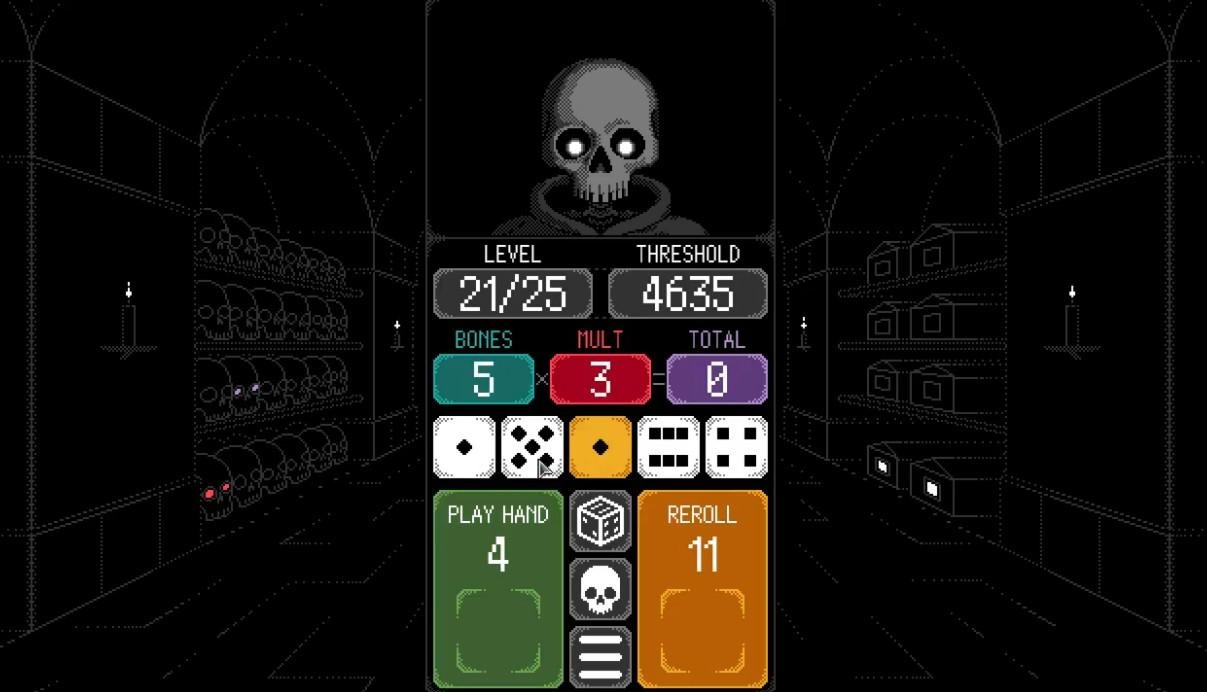
Dice of Kalma is an undeniably fun, smart, and slickly designed game. It distills the best elements of the deckbuilding roguelike genre into a format that is perfect for mobile sessions. The dice-rolling combined with the powerful skull synergies creates compelling runs where every decision feels weighty and consequential. It delivers on its promise to be a satisfying, strategic experience.
For players searching for a new high-value mobile gaming experience and those who enjoy deep, systemic strategy without the distraction of a free-to-play economy, Dice of Kalma is an immediate recommendation. It is a fresh take on a burgeoning sub-genre and has been recognized as a top contender for the Best Mobile Strategy Game of 2025 by several outlets. The technical performance is smooth, and the art style is sharp and distinctive.
However, its long-term success hinges on the forthcoming content updates. To truly become the high-roller that the community believes it can be, Pepperbox Studios must expand the depth of its systems and the variety of its content to ensure Dice of Kalma remains in the top tier of mobile gaming investment for years to come.
Overall Score: 8.5/10 – Must-Play for fans of deckbuilding and strategic roguelikes, but be aware that the post-launch content roadmap will be the key to ultimate longevity.
Dice of Kalma – Key Statistics & Buying Guide
For those looking to commit to this premium mobile title, here are the essential details:
- Developer: Pepperbox Studios
- Release Date: November 14, 2025
- Platforms: PC (Steam), iOS, Android
- Genre: Deckbuilding Roguelike, Strategy
- Business Model: Premium (Paid upfront, minimal IAP for cosmetics or permanent unlocks)
- Critical Reception: Highly Positive (Currently 89% positive reviews on Steam, well-received on App Store and Google Play).
- Recommended For: Players seeking high-engagement strategy, fans of titles like Slay the Spire and Balatro, and those prioritizing an excellent offline single-player experience.
H2: Deep Dive into the ‘Skull’ Deckbuilding Mechanic
The “skull” system in Dice of Kalma is what truly elevates the game beyond a simple dice roller. It transforms the experience from pure chance into calculated risk management and strategic planning. A deeper understanding of these mechanics is vital for players aiming for the highest scores and successful runs.
There are typically three primary categories of skulls you will encounter:
- The Economic Skulls: These affect your gold income, shop refresh costs, or the price of other skulls. They are crucial for early-game scaling and maximizing your mid-game power spike. Acquiring a skull that grants bonus gold for every successful roll early on can set up a dominant run.
- The Modifier Skulls: These are the core of your deck’s synergy. They modify dice values (e.g., +1 to all odd rolls), grant extra re-rolls, or change the conditions for scoring. Stacking a few strong modifiers that interact with the same numbers (e.g., two skulls that both benefit rolls of ‘6’) is the path to achieving the highest damage output and score required to defeat Kalma.
- The Utility Skulls: These provide defensive or situational effects, such as a one-time save from a failed round, or the ability to “hold” a single die between rounds. While less flashy than the modifier skulls, they are essential for mitigating the randomness factor inherent in a dice game and increasing the overall session stability.
Strong resource management is key, and players must constantly weigh the cost of a skull against its potential contribution to a high-score run. The CPC value of in-game strategy guides often highlights this tension, as maximizing early-game gold farming is the de facto strategy for success.